A Guide for Physicians
and Other Healthcare Providers
Healthcare Leadership
By Suzanne Tanner

How Healthcare Leaders Can Build Unit Culture That Prevents Burnout and Strengthens Patient Care
Healthcare team leaders shape more than daily operations; they influence whether nurses, physicians, technicians, and support staff feel connected, respected, and supported through demanding clinical work. A strong unit culture creates an environment where colleagues trust one another, share responsibility, and maintain compassion even under pressure.
Yet culture rarely develops automatically. It requires deliberate leadership, consistent habits, and opportunities for meaningful connection.
What Strong Unit Culture Really Means
Healthy unit culture is built on psychological safety, mutual respect, shared identity, and dependable teamwork. For healthcare leaders, three priorities matter most: make space for honest conversations, recognize contributions consistently, and establish traditions that help employees feel they belong.
These practices strengthen relationships, but they cannot replace safe staffing, manageable workloads, or organizational support. Lasting improvement requires both human connection and practical working conditions.
Why Dedicated Clinical Teams Still Feel Disconnected
Healthcare professionals can share demanding responsibilities without developing meaningful relationships. Often, the problem isn't commitment. It's the environment surrounding their work.
Several pressures quietly undermine unit cohesion:
● Constant staff turnover: Departures disrupt established relationships, while incoming employees must repeatedly learn unfamiliar team dynamics.
● Relentless workloads: Patient demands, documentation, and unpredictable emergencies leave little opportunity for personal connection.
● Metrics-first leadership: When performance dashboards dominate conversations, employees may feel valued primarily for productivity.
● Missing shared identity: A unit defined only by assignments and shift schedules struggles to develop lasting collective purpose.
Over time, these conditions can encourage emotional withdrawal. Employees continue providing care, but their connection to colleagues weakens.
The solution begins with recognizing culture as an operational responsibility rather than an optional morale initiative.
Small Rituals That Change the Atmosphere
Culture becomes visible through repeated behaviors. A manager who remembers an employee's difficult week, a colleague who recognizes another's excellent judgment, or a team that checks in after a distressing event reinforces belonging.
Consider how everyday practices address common workplace challenges:
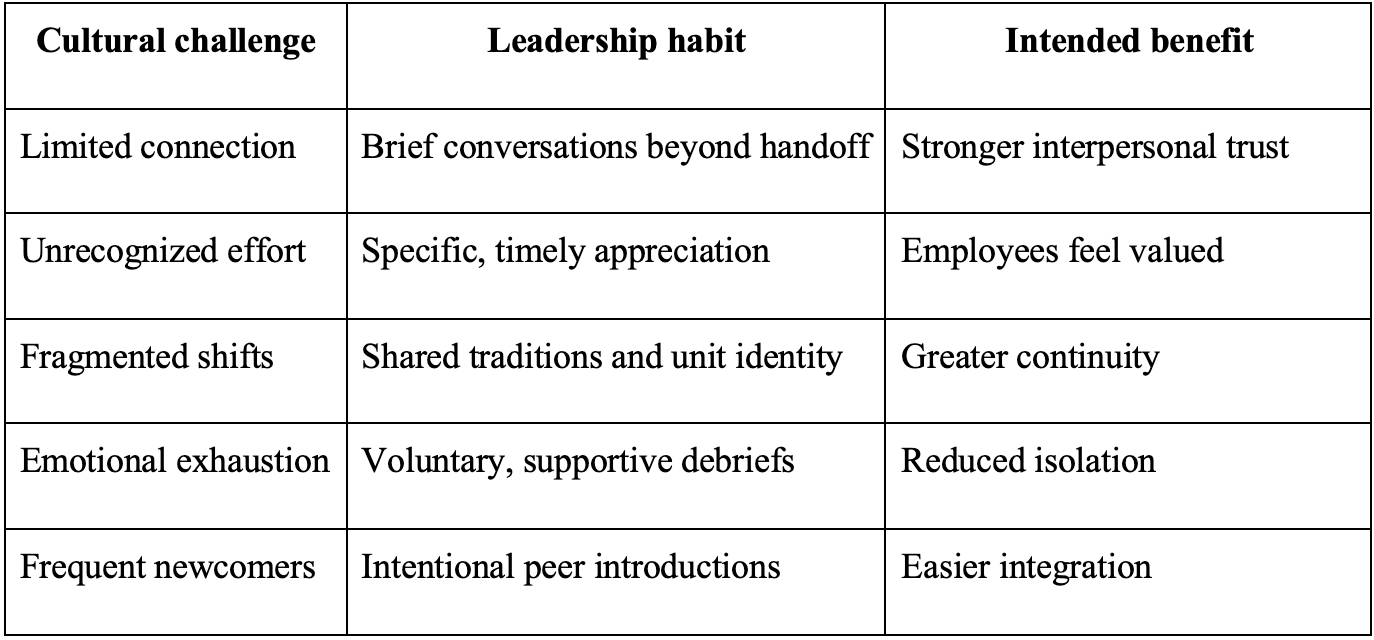
These actions work best when they become predictable. An occasional appreciation event cannot compensate for months of neglect.
Give Your Team Something That Represents Them
A recognizable team identity can create continuity in healthcare units where employees rotate across shifts and temporary staff regularly join established groups.
Some departments use custom-printed t-shirts featuring their unit's name, hospital affiliation, or a short message reflecting shared values. Custom Ink offers group apparel printing, allowing you to discover your t-shirt options and explore designs suited to different budgets. Matching shirts can give employees a tangible reminder of their connection to the unit during appreciation gatherings, community events, and informal moments outside clinical duties. They aren't substitutes for supportive leadership, but they can reinforce pride in a team whose members rarely work simultaneously. Any design should follow hospital branding and infection-control policies.
A Practical Checklist for the Next 30 Days
Building a healthier workplace doesn't require launching another complicated program. Start with manageable commitments.
● Week 1 — Listen: Ask employees what makes them feel supported and what creates unnecessary friction. Provide confidential feedback options.
● Week 2 — Connect: Introduce brief, voluntary check-ins that address team experiences without duplicating clinical handoffs.
● Week 3 — Recognize: Highlight specific examples of compassion, collaboration, and peer support across every shift.
● Week 4 — Reflect: Review feedback, identify recurring concerns, and communicate one concrete improvement leadership will make.
Invite night-shift employees, floating personnel, and quieter team members into the process. Culture should not depend on who happens to attend daytime meetings.
Why Belonging Matters to Patient Safety
A supportive unit culture benefits more than employee morale.
When clinical teams communicate openly, employees may feel more comfortable raising concerns, requesting assistance, and questioning unclear instructions. These behaviors support safer coordination and more attentive patient care.
The National Academy of Medicine's National Plan for Health Workforce Well-Being emphasizes that organizational conditions and workforce wellbeing are important foundations for delivering high-quality, patient-centered care.
Importantly, workplace connection should complement efforts to address staffing shortages, excessive administrative burdens, and inadequate recovery time—not distract from them.
Common Questions About Healthcare Unit Culture
How can leaders improve morale without adding meetings?
Incorporate recognition into existing routines and offer optional conversations during protected time. Avoid creating additional unpaid responsibilities.
Can stronger team culture eliminate burnout?
No. Positive relationships provide support, but burnout also requires organizational responses to workload, staffing, scheduling, and working conditions.
How do leaders know whether culture is improving?
Monitor employee feedback, psychological safety, retention trends, and participation in improvement efforts. Compare results across shifts rather than relying on isolated anecdotes.
A Useful Framework for Everyday Teamwork
Healthcare leaders seeking practical guidance can explore the Agency for Healthcare Research and Quality's TeamSTEPPS resources.
This evidence-based teamwork program provides approaches to communication, leadership, mutual support, and team coordination. Its briefing, huddle, and debriefing practices offer adaptable starting points for strengthening daily collaboration without relying solely on informal goodwill.
Culture Is Part of the Care Environment
Strong clinical culture is built through ordinary actions repeated consistently. Leaders who protect meaningful connection, acknowledge emotional strain, and address operational barriers create better conditions for teams to thrive. Over time, these commitments can strengthen employee wellbeing and support compassionate, coordinated patient care.
Disclaimer | Privacy Policy | Copyright | Sitemap | Contact | Comments

 |
 |

Disclosure: As an affiliate for SBI, Google and Amazon, this site may earn a small commission on ad links leading to qualifying purchases. These links are clearly marked as 'ads' or 'sponsored links', or with a √ checkmark.

Rod of Asclepius Wall Emblem (ad)


Caduceus 3D Wall Emblem over Hippocratic Oath (ad)


(Sponsored Links)
Recent Articles


-
Healthcare Leadership
Nov 03, 26 11:47 AM
 How Healthcare Leaders Can Build Unit Culture That Prevents Burnout and Strengthens Patient Care
-
The Art of Patient Care
Oct 18, 26 05:59 PM
 Introduction to The Art of Patient Care - a website dedicated to improving the quality of medical care by studying and emphasizing basic humanitarian concepts.
-
How to Successfully Earn Your Online Degree and Advance Your Career
Aug 12, 26 09:18 AM
How to Successfully Earn Your Online Degree and Advance Your Career